

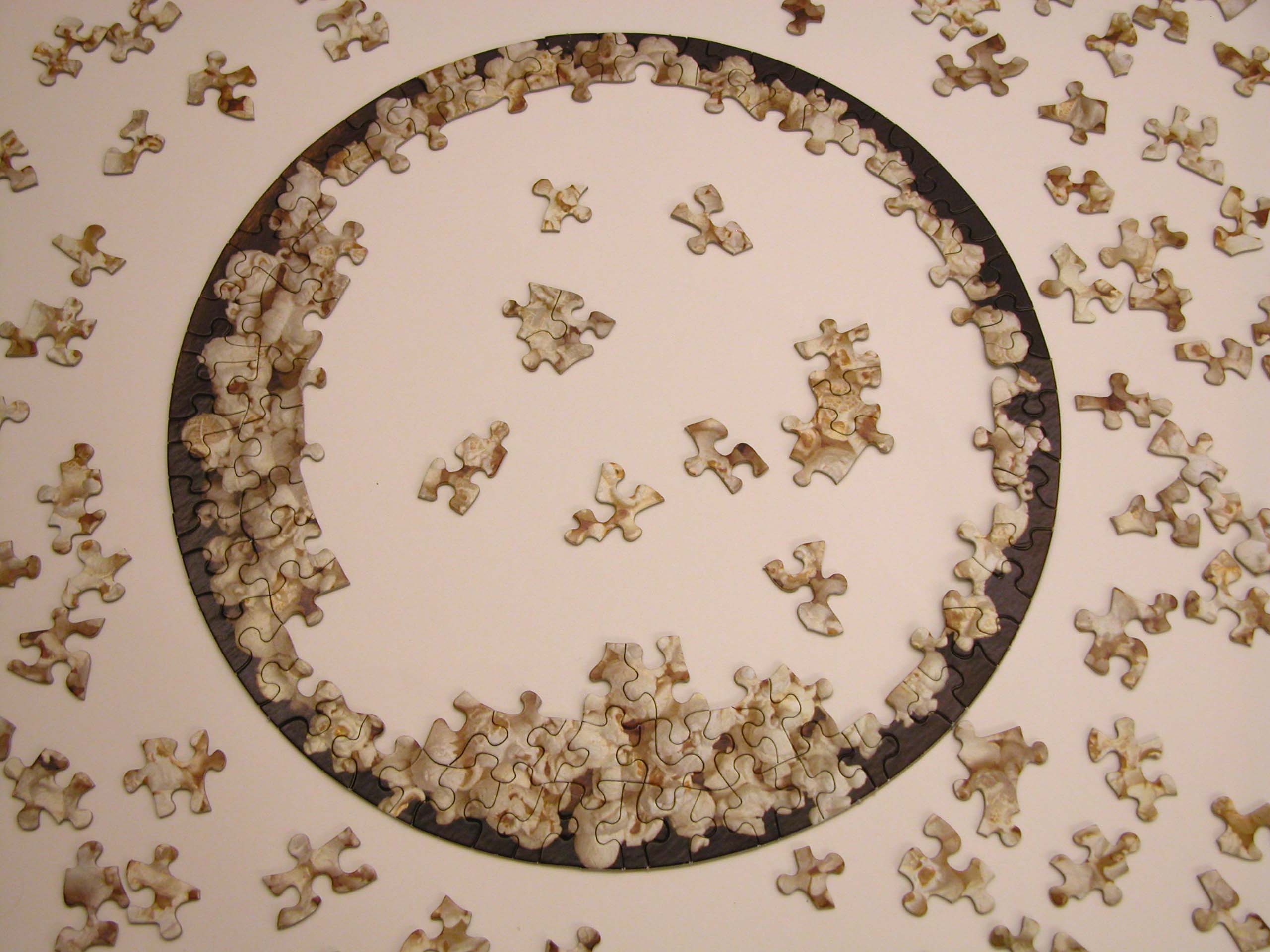
Herman Wolf’s Popcorn Puzzle

Popcorn puzzle

What does a round puzzle of a bowl of popcorn have to do with Herman Wolf?   What about an assortment of brightly colored shapes?

Abstract puzzle

We’re not sure.  Herman Wolf’s earlier years were filled with membership in the Socialist Party and government employment.  During the second World War, Wolf’s governmental employment was extensive.   He directed labor-public relations for the British Mangement-Labor Commission, wrote a war handbook entitled Labor Defends America, and directed a staff for the War Production Board, which supplied  war plant Labor-Management Production Committees with ideas and materials for impoving efficiency.    After the war, Wolf spent two years as Director of the Fuller House, Inc. of Wichita, Kansas, a corporation created to promote the building of R. Buckminster Fuller’s Dymaxion Dwelling Machine (the Fuller House). In 1946, he moved to Connecticut and began Herman Wolf Associates, a public relations firm.  He was involved in politics, serving as chief campaign aide in the successful campaigns of Abe Ribicoff, John Dempsy and Ella Grasso. 

In 1972, Wolf closed down his public relations firm for a brief time to become Executive Vice President of the Design Science Institute of Washington D.C., a nonprofit organization dedicated to advancing the philosophy and works of R. Buckminster Fuller.   

These puzzles are a part of his collection, and could be public relations pieces, architectural designs, or maybe just a hobby.  I think they are examples used for the war plant committees of how a staff spending time doing puzzles can be inefficient (thanks Megan and Dan!)  For more information on Herman Wolf, please see his online finding aid.

‘Archives on the Road’ is coming to you!

Join archivists from the Dodd Research Center as they give advice on what you can do to preserve your memories at home.  So bring your treasures and we’ll see you there!!

Thursday, April 16
7:00pm

Second Congregational Church
Route 44
Coventry, CT

Suggested donation of $5 to help repair the roof of the Strong Porter Barn in Coventry.
RSVP to jean.nelson@uconn.edu

Sponsored by the Dodd Research Center, Coventry Historical Society and the New England Archivists.

Words ‘Alive Like Animals’: An Exhibit of Beat Writers

corso_text_archives_doddresearchcenter

To celebrate National Poetry Month, a new exhibit showcasing works of Beat writers in various media from 1957 to 1966 opens April 6, 2009 at the Dodd Research Center.  The exhibit features letters, manuscripts, little magazines, photographs and audio recordings from the extensive literary collections held by the Center’s Archives and Special Collections.


Post-war America of the 1950s witnessed a blending of cultural influences and the emergence of new forms of performance, music, and visual arts.  Recent scholarship on writers and writings during this period emphasizes the role that art, media and popular culture had on the American literary imagination and on expressions of the individual in society.


Beat writers including Jack Kerouac, Allen Ginsberg, Gregory Corso and William S. Burroughs experimented with literary narrative, forms and mediums whether in reaction to or as a result of social and cultural influences of their time.  This exhibit highlights the works and collaborations of Beat writers from the 1950s and invites viewers to explore further questions.  What role did form and media play in making the work of the Beats known, available and accessible to readers?  How or did the threat of media censorship impact expression?  Did Beat writers help to usher in a new print culture or, rather, did they aim to dismantle it?  How or can literature shape a movement?


View “Words ‘Alive Like Animals’: An Exhibit of Beat Writers” at the Thomas J. Dodd Research Center, McDonald Reading Room Gallery, April 6 to May 2, 2009.  Gallery hours: 12:00 to 4:00, Monday through Friday.


Exhibit curated by Benjamin Miller, B. A. candidate in English, University of Connecticut.

“Principles, Politics and Leadership: The risks and rewards of staying true and speaking honestly in Washington”

Christopher Shays

Christopher Shays

If you would like to get insight into one of Connecticut’s most successful and controversial congressmen, join us for a discussion with former U.S. Representative Christopher Shays on Tuesday, April 7 at 5:00pm.

Represenative Shays spent 21 years in congress as a moderate Republican, often clashing with his own party on his social views. His entire career is a story of how politicians can successfully stay true to themselves and their issues.

Dodd Research Center’s New Hours

Effective March 30th, the John McDonald Reading Room at the Dodd Research Center will be open from Noon until 4pm, Monday through Friday. While this means less hours to access our collections in the reading room, our commitment to serve our patrons has not diminished. Our curators are still available to offer instruction sessions, assistance with class projects and individual research consultations. And don’t forget, we offer a wide range of online resources which are at your disposal 24 hours a day!

Our exhibit galleries are also not affected by this change, they are still availble for your viewing from 8:30am-4:30pm Monday through Friday.

“The Last Best Hope of Earth? American Democracy and the Right to Vote in Historical Perspective.”

Professor Adam Fairclough
Professor Adam Fairclough, the Sackler Chair in U.S. History at Leiden University in the Netherlands will be giving the Spring 2009 Raymond and Beverly Sackler Distinguished Lecture in Human Rights on

Tuesday, March 31, 2009
4:00pm, Konover Auditorium

Professor Fairclough’s first book, To Redeem the Soul of America: The Southern Christian Leadership Conference and Martin Luther King, Jr. (1987) won an Outstanding Book Award from the Gustavus Myers Center for the Study of Human Rights. Race and Democracy: The Civil Rights Struggle in Louisiana , 1915-1972 (1995) was the recipient of the Louisiana Literary Award, the L. Kemper Williams Prize for the best book in Louisiana history, and the Lillian Smith Book Award of the Southern Regional Council. His most recent book, A Class of Their Own: Black Teachers in the Segregated South won the 2008 Outstanding Book Award of the History of Education Society

Join us as we welcome one of the leading scholars in the study of the American Civil Rights Movement.

Spring Has Sprung!

March 20, 1960

March 20, 1960

Even the most dedicated authors get a bit of “spring fever”. Edwin Way Teale, who devoted his life to nature and the environment, shows signs in his diary that he is thankful for spring to arrive during his first spring at “Trial Wood”, the newly purchased seventy-nine acre property he and his wife Nellie purchased in Hampton, CT.

We drive to Willimantic for Sunday papers – walk in woods and down lane to see pussywillow tree in the afternoon.”

He further states that he should be working on Chapter XXI (of “Journey Into Summer”) but “seem to have spring fever!”

(in the interest of full disclosure, we should also let you know that 6 days later on March 26, it was 0 degrees at dawn) Enjoy Spring!

Gallery Talk “Observations of Post-Soviet Life”

Sunday Benches, Sillamae

Sunday Benches, Sillamae


Artist Sara Rhodin will present a gallery talk and lecture on Tuesday, March 24, at 4 p.m., in the Konover Auditorium with a reception to follow. The exhibit, titled “Transitional Spaces in Post-Soviet Estonia” is on display in the Dodd Center West Hallway Gallery through April 20.

Ms. Rhodin was a Fulbright Scholar in Estonia in 2006/2007 and a New York Times intern in Moscow in 2008. She is currently a graduate student in Russian and East European studies at Harvard University.

Sponsored by the Office of International Affairs, European Studies, and the Human Rights Institute.

Spring Buzz

For those that keep honey bees, or enjoy reading about those that do, this season of thaw and mud is a busy one spent studying, observing, and nourishing healthy bee activity. And as we learn, much remains unknown about the wonderful world of bees. The latest addition to the large collection of historic books, pamphlets and periodicals on beekeeping and apiculture at the Dodd Research Center is a set of unique, handwritten journals by Connecticut resident Charles Pease. “Charlie” as he was known, was born in 1866 and in 1923 moved his successful printing business to Canaan, where he lived most of life. A naturalist and advocate of self-sufficient homestead living, Charlie grew proficient in keeping bees and goats, educating others about his practices as well as the medical benefits of honey and goatsmilk. Charlie’s journals date from 1919 to 1949 and are a fascinatingly personal document of bee-keeping practices, hive behavior, seasonal observations, and inventiveness.

Charlie Pease's 1946 journal

Charlie Pease's 1946 journal

Charlie Pease's 1927 Journal

Charlie Pease's 1927 Journal

Mesmerizing Miniatures: Bookplates Digital Collection

Sample the variety of imagery, designs and printmaking techniques available in the latest addition to the Dodd Research Center’s digital collections: bookplates!  These small artworks, produced to uniquely identify books with their owners and their libraries, illustrate etching, engraving, lithography and woodcut techniques of artists and printmakers from around the world.  The bookplates collection is a component of a large collection of resources that document Ex Libris and the book arts available at the Dodd Center.  Browse over 300 images represented in the digital collection currently.  Additions will follow in the coming months.

Ex Libris Collection, Archives and Special Collections at the Thomas J. Dodd Research Center, University of Connecticut Libraries

Bookplate by Gerard Gaudaen for Lou Asperslag

Early Photographs of UConn Now Available Online

The earliest photographs of UConn, held at the Dodd Research Center, were made by Harry L. Garrigus, UConn class of 1897 and instructor of animal husbandry. 500 of his glass plates dating from the late 1890s are now available online through UConn Libraries’ Digital Mosaic.  To browse the collection, select the Garrigus Photograph Collection and search.  UConn’s agricultural heyday and growth are documented, as well as early administrators, staff and townspeople.  We’re adding new images weekly, so check back with us for more.

Judging sheep, 1912

Judging sheep, 1912

Fruit trees near poultry buildings, 1897-1912

Fruit trees near poultry buildings, 1897-1912

Glass plate negative

Glass plate negative

Welcome to the Dodd Research Center’s Official Blog!

Welcome!  There is always something new and exciting to be found in the archives at the Dodd Research Center.  ‘Fresh Pickin’s’ will allow us to bring those things to you.  We will reach into our own abundant orchard, found right here at the University of Connecticut, and offer regular highlights from our collections and keep you up to date on our programs.

It’s a work in progress – so come along for the ride and tell us what you think!