The International Conference on Crisis Mapping will be held in Boston, MA October 1-3, 2010. The goal of this conference is to bring together engaged practitioners, scholars, software developers, and policymakers at the cutting edge of crisis mapping with focus on crisis mapping applications in the disaster response to Haiti and beyond. If you are interested in learning more about crisis mapping applications, be sure to check out the ICCM 2010 Conference Website for more details.
Did You Know #31 – Natural Earth
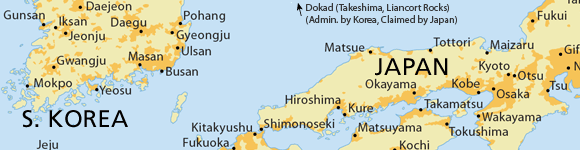
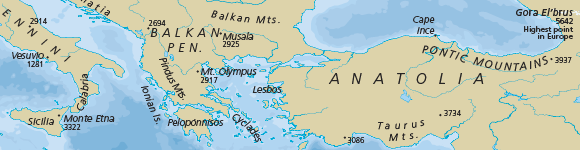
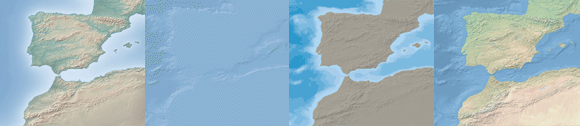
Did you know you can get free GIS Data in both Vector and Raster format for the entire world? Natural Earth Data provides three scales of data at:
1:10,000,000
1:50,000,000
1:110,000,000
These might seem like really small scales (and they are!), but if you’re mapping global data it’s more than suitable! Additionally all the data is in the same format/projection. Featured data themes include:
- Countries
- Disputed territories
- First order administration
- Populated Places
- Urban Places
- Parks and Protected Areas
- Pacific Nation Groupings
- Water boundaries
- Railroads!
- Coastline
- Land
- Ocean
- Minor islands
- Reefs
- Physical Region Features
- River and Lake Centerlines
- Lakes
- Glaciated Areas
- Antartic Ice Shelves
- Bathymetry
- Geographic Lines
- Graticules
Did You Know? #29 Location Sharing Technologies and Your Privacy
With a wide range of location sharing enabled applications for mobile devices (e.g. Gowalla, Foursquare) users may be wondering how privacy is impacted by all of these location enabled applications. On July 27, 2010 EDUCAUSE hosted a webinar titled “Location-Sharing Technologies – Privacy Risks and Controls” with Lorrie Faith Cranor from Carnegie Mellon University which discussed several issues related to privacy with location based information. This webinar broadcast was recorded and can be viewed in its entirety at the EDUCAUSE Live! Archive.
What are your concerns with privacy and location sharing enabled applications? Let us know by commenting on this blog.
GPS Navigation – Destination… The Heart.
So this post has been up on CNN for a while now, but it’s fun and light hearted so why not repost it here? Enjoy!
With new GPS dating apps, it’s love the one you’re near
ArcGIS for iOS Available.
ESRI has released ArcGIS for the iPhone and iPad and is now available for download from the App Store. For images related to the App release please see Veryspatial.com for a review and the iTune web page for to download the app for free.
‘Climategate’ review clears scientists of dishonesty – CNN.com
Where are all the Birds?
As a follow up to the National Pollinator Week 2010 post, I found some very interesting bird atlas projects online that map the distribution of bird species. What’s even better about these projects is that data collection is largely done by volunteers. Why is that good news? It means that if you are looking for a new hobby or to put your birding skills to the test your in luck. Below are some links to some bird atlas projects. The one I’m most familiar with is the Pennsylvania Breeding Bird Atlas, but you should really check out them all if you’re interested! Anybody ask what you could do with a degree in geography? Check out this dream job of a friend of mine to see what she does on a daily basis. Jealous? I am.
- Massachussets Breeding Bird Atlas
- Wisconsin Breeding Bird Atlas
- New York State Breeding Bird Atlas
- Florida Breeding Bird Atlas
- Pennsylvania Breeding Bird Atlas
- Ohio Breeding Bird Atlas
- Minnesota Breeding Bird Atlas
- Michigan Breeding Bird Atlas
- Maryland Breeding Bird Atlas
- Delaware Breeding Bird Atlas
- West Virginia Breeding Bird Atlas
- Texas Breeding Bird Atlas
- Louisiana Breeding Bird Atlas
- Iowa Breeding Bird Atlas
- South Carolina Breeding Bird Atlas
- Vermont Breeding Bird Atlas
- Colorado Breeding Bird Atlas
- South Dakota Breeding Bird Atlas
- Oregon Breeding Bird Atlas
- Arkansas Breeding Bird Atlas
- Kansas Breeding Bird Atlas
- Missouri Breeding Bird Atlas
- Nebraska Breeding Bird Atlas
- Alabama Breeding Bird Atlas
- New Jersey Breeding Bird Atlas
Atlases hosted by Cornell Lab of Ornithology
Bird Atlas of Britain and Ireland 2007-2011
Happy weekend to all the aspiring ornithologists and geographers!
National Pollinator Week 2010 – Extra from the White House!
Inside The White House – Bees! from The White House on Vimeo.
This beehive on the South Lawn is a first for the White House. The busy bees pollinate the kitchen garden, flora all over Washington and provide honey for the White House kitchen. Take a look at this year’s colony, estimated at about 70,000 bees, and listen to how the idea for a beehive on the South Lawn came about.
National Pollinator Week 2010
It’s National Pollinator Week 2010! We depend on many species to pollinate our crops so that we have a dependable food resource. Unfortunately many species of pollinators are at risk including:
I first learned about National Pollinator Week from a USGS news post and found some interesting links. A few of these include a few podcasts (Bees Are Not Optional, Pollinators, Phenology, and Climate Change) that interview scientists who research pollinating species. One of the most interesting was a link to Butterflies and Moths of North America. This site has a distribution map that allows you to first find an area of interest, then see lists of species found in that area. Below is an example of a species that is found in Connecticut.
Your browser does not support iframes.
For more information on National Pollinator Week 2010 and to see what activities may be happening in your neighborhood please visit http://www.pollinator.org/
More on Climate
I’d like to introduce the readers of Outside the Neatline to another blog that is really well done in regards to covering climate change/global warming and weather in general. The name of the blog is Dr. Jeff Masters’ Wunderblog and is hosted at the Weather Underground website. In his June 17, 2010 post, Dr. Jeff Masters reviews the most recent report from the National Climatic Data Center and features the figure below:
Additionaly, the Intergovernmental Panel on Climate Change (IPCC), Working Group II has announced the names of the 831 authors of the Fifth Assessment Report (AR5). This is a first of many steps towards the next large Assessment Report. In line with the announcement I’ve included some links to presentations given by some of the working groups as they prepare for AR5. The following presentations were given at the:
United Nations Climate Change Conference, COP 15 IPCC Side Event “IPCC Findings and Activities and their Relevance for the UNFCCC Process”Copenhagen, Denmark, 8th December 2009
– Mr Thomas Stocker Co-Chair of WG I
Impacts, Adaptation, and Vulnerability – Main Findings and New Features of the WG II Report
– Mr Chris Field Co-Chair of WG II
IPCC Special Report on Managing the Risks of Extreme Events and Disasters to Advance Climate Change Adaptation
– Mr Vicente Barros Co-Chair of WG II
Fifth Assessment Report (AR5)
– Mr Youba Sokona Co-Chair of WG III
IF you would like more information about climate change in the United States of America, check out the EPA’s Climate Change web page.